
Name-Based Case Searches
For a McDonald County case, the main public tool is Missouri Case.net. If you know the exact legal name, begin with Litigant Name Search. The live form may let you narrow by court, county, type, or date. Use those filters to zero in on McDonald County or the 40th Circuit. Read party roles and case types after that. One caution: a name hit might be a party, an attorney, or some other listed role. Open the case header first. Confirm you have the right file.
Spelling counts. A protected child, victim, witness, sealed party, or non-litigant may never surface in public results. Name searching in McDonald County locates public cases; it does not promise every case tied to a person. When results run broad, tighten them. Use a filing period, a complete case number, or an official notice. Skip the endless guessing at spelling variations.
- Open Case.net and choose Litigant Name Search.
- Enter the person or entity name as it appears on the court notice or known case record.
- Use McDonald County, 40th Circuit, court type, or date options when the live form permits them.
- Open a result and compare the party role, case type, and filing date with the known facts.
- Read the case header and docket entries only after confirming that the result is the relevant McDonald County case.
The official workflow describes search concepts rather than fixed labels. Case.net's live selectors should be checked in a normal browser, since the system's choices can shift.
| Search input | Type | Needed | McDonald County use |
|---|---|---|---|
| Litigant name | Text | A name is needed | Use the exact legal name and confirm the party role in the case header. |
| Court or county | Live-form option | Optional | Narrow to McDonald County or the 40th Circuit if that option is available. |
| Case type | Live-form option | Optional | Use after a known civil, criminal, probate, traffic, or municipal context emerges. |
| Filing date or range | Date input | Optional | Limits a search to a known filing period, not every later case event. |
McDonald County Docket Search Modes
Case.net documents four ways to find a McDonald County court docket: Litigant Name Search, Filing Date Search, Case Number Search, and Scheduled Hearings & Trials Search. Each serves a different job. A name search starts from a party. Filing Date Search suits a known filing window. Case Number Search is the strongest option when the whole identifier sits on a notice or a clerk reference. Scheduled Hearings & Trials is the calendar route for an upcoming public setting.
That calendar is not the full docket, though. Its current form can filter by court, date range, judge, location, or calendar as the live system permits. Public results can omit confidential cases. They can also omit settings that shifted after publication. Before a McDonald County hearing, weigh the search result against the latest notice. If a time or setting stays unclear, call the clerk.
- Litigant Name Search
- Finds public cases through a listed party or entity, subject to the public access limits on names.
- Filing Date Search
- Uses the date or date range when the case began, not a guarantee of later court activity.
- Scheduled Hearings & Trials
- Finds upcoming public settings and is not a substitute for a complete docket history.
Case Number Searches
Nothing beats a complete case number for pulling up a known McDonald County court docket. Missouri relies on statewide Judicial Information System number families. Older converted numbers can combine a circuit prefix, category code, location, year, and sequence. Interim numbers pair a year with codes and a six-digit sequence. Newer constructions use a year, a location, a case-type code, a five-digit sequence, and a subcase code. No public source confirms a safe McDonald location code.
Enter the identifier exactly as given. Never convert a uniform citation number into a court case number. The 40th Circuit number is not a location segment. Newer criminal work may carry CR. Civil cases carry CV. Probate uses PR, and older converted criminal records carry R. Those letters name statewide families, not a full local decoding key.
A municipal case can move into an associate or circuit division. It may pick up a new number there. Each criminal defendant gets a separate file number too. In a McDonald County docket search, keep leading zeroes, hyphens, and letter codes intact. When a code looks strange, ask the clerk. Do not guess at its location or case type.
McDonald County Docket Number Codes
McDonald County court records speak the statewide Case.net and JIS vocabulary. A docket sheet is the compiled event record. A backer sheet is the citation-oriented docket summary. It can carry charge, bond, hearing, disposition, and sentence fields. The case header is the identifying block. It holds the case number, court, type, parties, and basic status. Trust these plain terms over treating an abbreviated code as a final answer.
Some statewide labels show up only in supporting materials. No public McDonald County event-code dictionary exists. JIS material, for instance, defines labels. It covers judgment sheets, backer sheets, docket-code references, and redaction workflow. Seeing a system label does not guarantee that same code in every McDonald County result. The clerk can explain what an entry means in plain language. The court's order states the legal action.
Case Search Results Explained
Start at the top of any McDonald County case search result. That header carries the county or city, case type, case number, parties, and attorneys. Court Operating Rule 4 treats the automated record as filed documents plus the docket or backer sheet. The docket itself works as an index and an event history. A single line can summarize a court action. It may cover a judgment or order, without giving you the full text of the document behind it.
Work through the result in layers. Confirm the caption first: party role, case type, filing date. Then read the docket entries in order, chronologically. When a public document is linked, open it. A McDonald County case can be public. One specific filing may still sit outside remote view. An unlinked entry may simply mean no attachment exists, or your access level may not permit it.
| Case header | Shows the court, case number, type, parties, attorneys, and basic status information. |
|---|---|
| Docket entries | Provide a dated chronology of filings, events, hearings, orders, judgments, and related actions. |
| Scheduled hearing | Can identify a future public setting; the individual notice or clerk confirmation controls. |
| Document link | Can open a public filing when security permits and the document is linked. |
| Judgment data | Can show result-specific fields, but a full signed judgment may require a clerk request. |
McDonald County Docket File Viewer Access
A docket entry and the document behind it are two different things. The Case.net File Viewer help draws that line clearly. A filing shows a public link only when security permits it. A McDonald County case with no link may simply have no attached document. The current access level may also block remote viewing. Either way, the entry still gives you the event history. It is a solid starting point for a clerk request.
Documents filed on or after July 1, 2023 became remotely available circuit by circuit. Older McDonald County files may sit only on a courthouse public terminal. Staff can log a visitor into Case.net at that terminal. E-CASE files can require exactly that route. For a public copy or a certified record, the McDonald County Circuit Clerk is the office to call.
The File Viewer source draws a line. It separates a public link from a courthouse-terminal record.
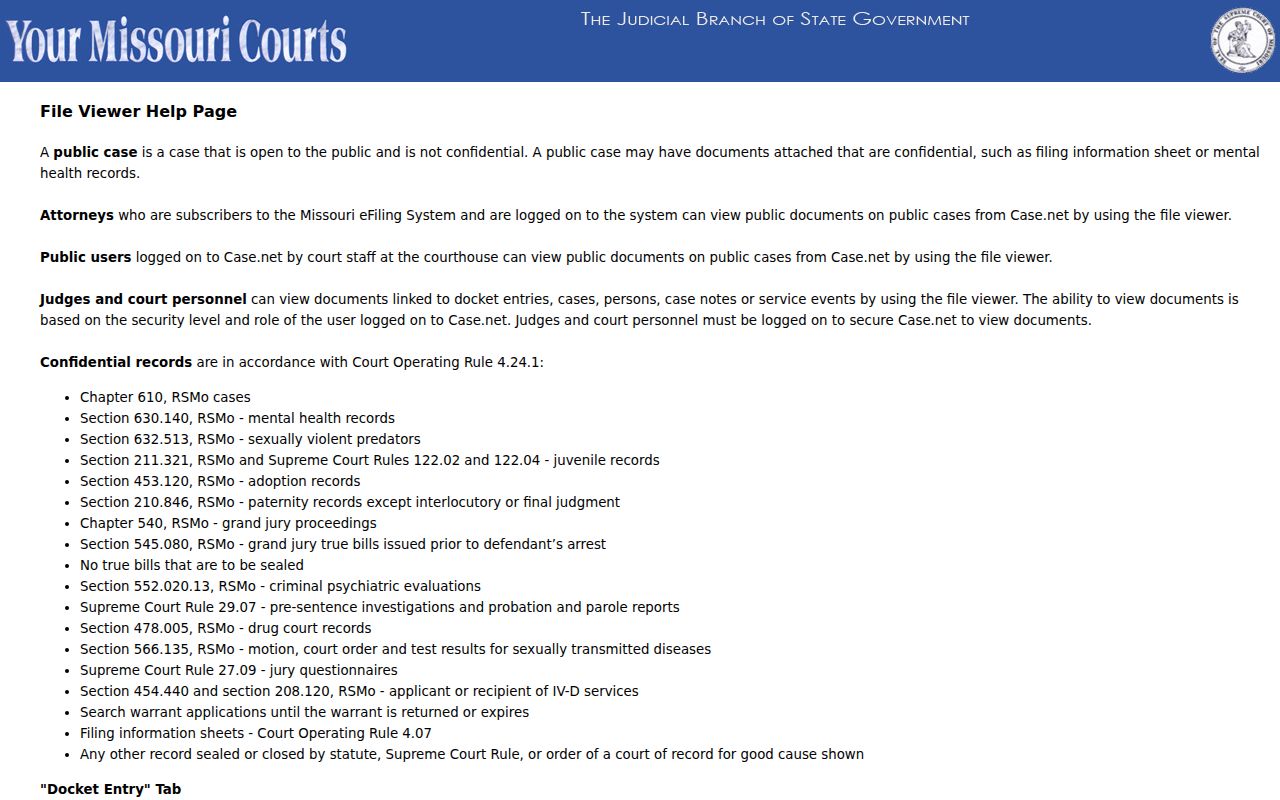
For a public case with an online history but an older filing that lacks a remote link, the courthouse terminal is the practical fallback for a McDonald County court docket.
Two Ways to Search: County and State
McDonald County offers no separate county-run case portal of its own. Instead, a McDonald County court docket search runs on two layers. Case.net is the statewide layer. It is the fastest way to pull a case header, case number, docket entries, and any linked public document. The local layer sits at the courthouse: the Circuit Clerk and the public terminal there. Use the state side to find. Use the clerk when a record needs confirmation, terminal access, or a certified copy.
These channels complement each other. A Case.net result tells you exactly what to request from the clerk. So keep the ask narrow: case number, parties, approximate year, and the item you want. The clerk can then point you to the right route for a public court record. One caution, though. Do not confuse the County Clerk's government-record process with a Circuit Clerk court-file request. They are separate.
| Search channel | Best use | Limit or next step |
|---|---|---|
| Statewide Case.net | Name, filing-date, number, and scheduled-hearing searches for McDonald County public cases. | Documents may be unlinked, restricted, or available only at a terminal. |
| McDonald County Circuit Clerk | Clarify a court file, request a public copy, or ask about certification and current requirements. | Provide the known case details and do not ask the clerk to interpret the outcome. |
| Courthouse public terminal | Review eligible public material, particularly older or E-CASE documents. | Access still follows document-security and confidentiality rules. |
McDonald County Case Search Notices
Track This Case is not the same as a standard McDonald County name search. The official sequence goes like this: pick a search tab, enter your criteria, open the case number, select Track This Case, supply an email plus an optional phone, work through the CAPTCHA or special-character steps, and submit. Once you have opened a known case, the feature can send handy updates on eligible public cases.
Treat those alerts as convenience, not law. Notifications are not official court notices, and the official guide lists real limits: the feature goes dark every Monday through Friday between 1:00 a.m. and 6:00 a.m. Central Time, and FCC cases cannot use it at all. To verify a hearing date, time, or required appearance, the case notice and the clerk remain the reliable sources. The official Track This Case instructions spell out the full notification workflow and its notice limitation.
Which Cases Stay Restricted
Not every McDonald County case search shows everything. Court Operating Rule 4 lists record types a court may close or keep confidential. The list covers juvenile, mental-health, adoption, grand-jury, and protected-victim files. It also includes criminal-evaluation, pre-sentence, and probation material, drug-court records, sealed or expunged cases, and anything a judge has ordered closed. Even when a case is public, its documents might not be. Those are two separate questions in any docket lookup.
Juvenile files and their social reports never count as ordinary public court records. A sealing order can shut off access. So can an expungement, a protected-victim rule, a separate court order, or a local clerk procedure in McDonald County. If you have a legal right to see the material, contact the Circuit Clerk. Use the formal court process. Do not treat a missing Case.net result as proof that a record does not exist.
Restriction sources: Court Operating Rule 4 lists public-access and confidentiality rules. RSMo § 211.321 addresses juvenile records. The Missouri juvenile-rule material confirms the restricted status of juvenile files.
McDonald County Case Judgment Searches
Court Operating Rule 4 splits judgment searches into two kinds. Civil judgment searches let you search by party, case number, or judgment date. What comes back is the party, the case number, the judgment date, the court or entity, the amount, any satisfaction or vacation date, and a short summary. Criminal and municipal judgment searches work from a defendant, case number, or judgment date instead. The results cover the defendant, case number, sentence date, and summary.
Treat those fields as a way to locate a case. They are not the court document itself. Case.net, the current interface, sometimes combines or renames these views. So rely on the live search options you see. For a McDonald County judgment, check the summary against the docket before trusting it. When you need the official paper, contact the Circuit Clerk for a certified signed judgment or disposition.
One caution worth keeping in mind. A missing linked document or an empty satisfaction field proves nothing. It does not show that no later filing, copy, or court action exists in the McDonald County record.